• Welcome to AlpineZone, the largest online community of skiers and snowboarders in the Northeast!

    You may have to REGISTER before you can post. Registering is FREE, gets rid of the majority of advertisements, and lets you participate in giveaways and other AlpineZone events!

Why do chairlifts have to be so high?

gmcunni

Active member
Joined
Feb 25, 2007
Messages
11,502
Points
38
Location
CO Front Range
The only plus side would be rescues would be easier, and if people were to fall they may have a better chance of walking away from it......
And it may enable people who have a fear of heights to hit the slopes....

i think this is the answer -

e58d36de_portillo2.JPG
 

Cheese

New member
Joined
Jan 4, 2012
Messages
999
Points
0
Location
Hollis, NH
It could also be the fixed grip chairs vs. detachable as well. Usually the fixed grips can work in higher winds than detachable.

Pretty sure this is a weight issue as full chairs are fine but the empty chairs going up and down swing violently in the wind. Perhaps a detachable quad is made from lighter materials and has more surface area to catch the wind than an old double?
 

MadMadWorld

Active member
Joined
Jan 10, 2012
Messages
4,082
Points
38
Location
Leominster, MA
Pretty sure this is a weight issue as full chairs are fine but the empty chairs going up and down swing violently in the wind. Perhaps a detachable quad is made from lighter materials and has more surface area to catch the wind than an old double?

Truely it can happen to any chairlift under certain conditions....remember it was a double at Sugarloaf that sent 8 people to the hospital. You are correct that the swinging of empty chairs can have a big affect on whether the rope comes off the bull wheel. Another factor is that there are generally few towers and reach higher elevations than a fixed grip lift. Those can be two big risk factors
 

dennis

New member
Joined
Mar 12, 2011
Messages
30
Points
0
I just told you the rule, I have only worked on ski lifts for 31 years so I don't know it all but I do know the rule

And for the record I do not guess, it is the ANSI B-77 standard for vertical clearances, and “all” chair lifts are 5 feet off the ground in at least two places. Fact, not a guess.
 

zakyr

New member
Joined
Jan 25, 2012
Messages
180
Points
0
Location
Mass
And for the record I do not guess, it is the ANSI B-77 standard for vertical clearances, and “all” chair lifts are 5 feet off the ground in at least two places. Fact, not a guess.

Yes sir.
 

SIKSKIER

New member
Joined
Nov 13, 2006
Messages
3,667
Points
0
Location
Bedford and Franconia NH
Cannon's upper mt Cannonball fixed quad is a low profile chair.I would guess its no higher than 20 feet at its highest point.There is only one place between the last 2 towers that it gets to its highest point to clear the only trail that goes under it.Twice I have been on this chair in spring fully loaded with 3 other 200+ friends(we figure we were close to 900 lbs total).Both good snow years and our skis actually touched the snow.Strange feeling indeed!
 

drjeff

Well-known member
Joined
Jan 18, 2006
Messages
19,637
Points
113
Location
Brooklyn, CT
Tell me a mountain that has a lift even close to 5 feet off the ground....if you can't then I would have to say your guess is incorrect.

Thus the discussion........

Dennis maintains a double chair that doesn't get too much further than 5 feet off the ground for it's entire length. It's also the only chairlift in Vermont without a safety bar.

What's really wild is when you're 6'3" tall and skiing down a trail where the tower height has a 1400 or so pound 6 passenger bubble lift probably not too much greater than the 13 foot minimum Dennis mentioned, and for various reasons the EMPTY bubbles are swinging a very good amount side to side on the haul rope seemingly right over one's head! That was both pretty cool and pretty freaky at the same time yesterday ;) :eek: ;)
 

legalskier

New member
Joined
Sep 22, 2008
Messages
3,052
Points
0
Insight? Thoughts?

You may find insights/thoughts in ANSI's document called "Passenger Ropeways - Aerial Tramways, Aerial Lifts, Surface Lifts, Tows and Conveyors - Safety Requirements," which is described thusly:
This document establishes a standard for the design, manufacture, construction, operation, and maintenance of passenger ropeways. For this standard, passenger ropeway categories include:...aerial lifts (detachable lifts, chair lifts, and similar equipment...). ***

The cost is $175.00 through their web store.
http://webstore.ansi.org/RecordDetail.aspx?sku=ANSI+B77.1-2011
However, if you become a member of the "B77 committee," which is open to the public, you probably will have access to it free of charge.

Many of the standards contained therein have been codified into law by various states. For example, the Colorado Passenger Safety Tramway Board's Rules and Regulations include air space requirements in subsection 3.1.1.3.2 (for detachable grip aerial lifts) and subsection 4.1.1.3.2 (for fixed grip aerial lifts). Here is the pertinent web page for your review: http://www.dora.state.co.us/tramway/rules/rules

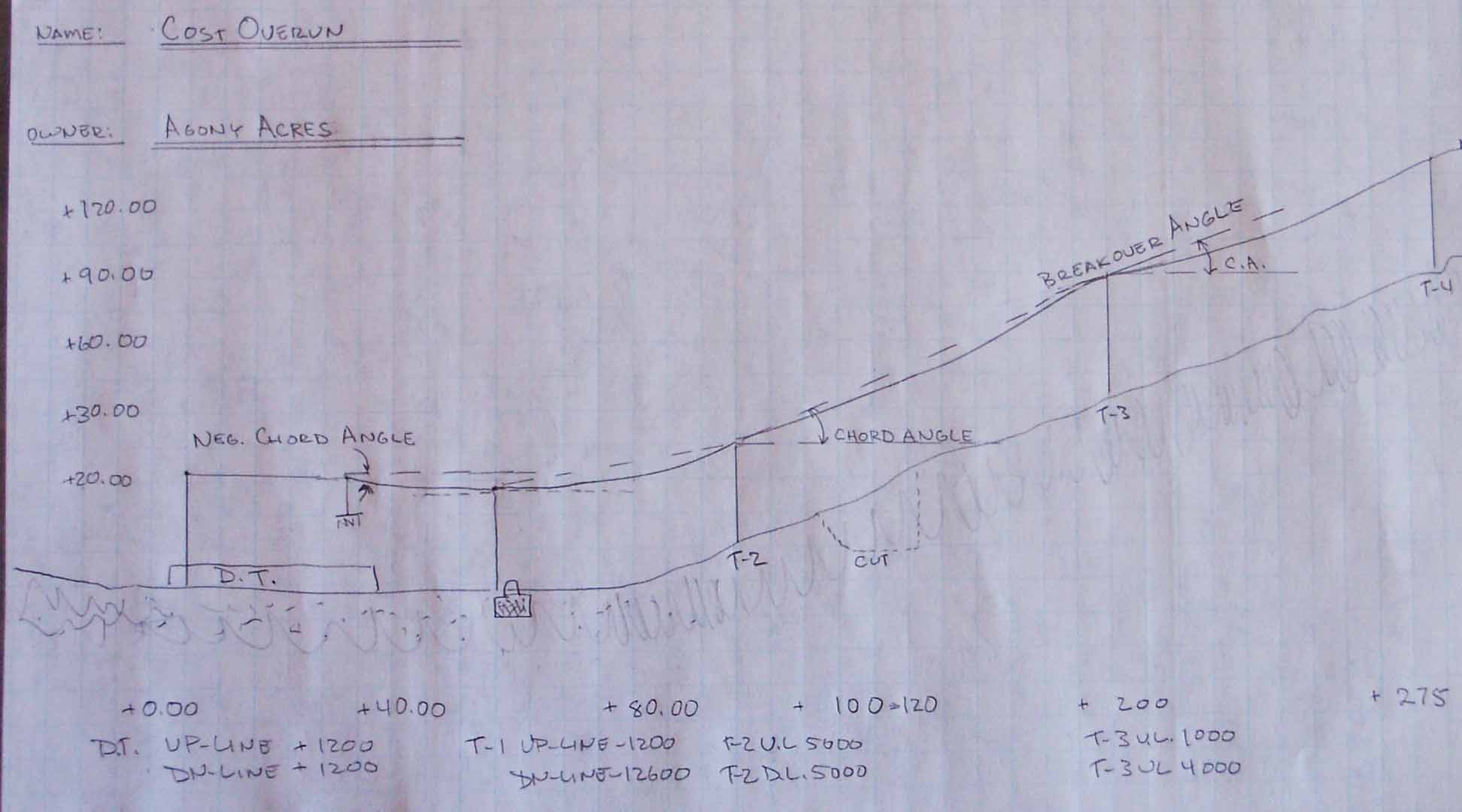
Some additional insight may be found at www.skilifts.org, specifically in the section regarding "negative cord angles," which includes this illustration:
negativecordangle.jpg

http://www.skilifts.org/old/tech_facts_negativecordangle.htm

After you're finished reviewing this information, please feel free to get back to us with the insights/thoughts you've found. You've piqued my interest so much that I eagerly await your analysis.
 
Last edited:

Telemechanic

Member
Joined
Nov 27, 2007
Messages
218
Points
16
If the resort does not want to ski under it they only need to maintain 5 feet of clearance from the lowest part of the chair, if they wish to ski under it they must maintain 13 feet of clearance from the top of the seat, this includes snow, these are measured in the lifts most adverse condition, that being fully loaded using the stop that causes the greatest dynamic condition, generally the emergency stop. Many lifts have points that are near 60 feet in the air and it’s not needed, but it will cost you to have it lower, it’s all about the profile of the lift line and how much money you have.

I'll add that gondolas only need 10 feet of clearance above an open trail.
 

dennis

New member
Joined
Mar 12, 2011
Messages
30
Points
0
You may find insights/thoughts in ANSI's document called "Passenger Ropeways - Aerial Tramways, Aerial Lifts, Surface Lifts, Tows and Conveyors - Safety Requirements," which is described thusly:
This document establishes a standard for the design, manufacture, construction, operation, and maintenance of passenger ropeways. For this standard, passenger ropeway categories include:...aerial lifts (detachable lifts, chair lifts, and similar equipment...). ***

The cost is $175.00 through their web store.
http://webstore.ansi.org/RecordDetail.aspx?sku=ANSI+B77.1-2011
However, if you become a member of the "B77 committee," which is open to the public, you probably will have access to it free of charge.

Many of the standards contained therein have been codified into law by various states. For example, the Colorado Passenger Safety Tramway Board's Rules and Regulations include air space requirements in subsection 3.1.1.3.2 (for detachable grip aerial lifts) and subsection 4.1.1.3.2 (for fixed grip aerial lifts). Here is the pertinent web page for your review: http://www.dora.state.co.us/tramway/rules/rules

Some additional insight may be found at www.skilifts.org, specifically in the section regarding "negative cord angles," which includes this illustration:
negativecordangle.jpg

http://www.skilifts.org/old/tech_facts_negativecordangle.htm

After you're finished reviewing this information, please feel free to get back to us with the insights/thoughts you've found. You've piqued my interest so much that I eagerly await your analysis.

and that any ropeway installed prior to the date of this standard need not comply unless the changes are operational.
 

dennis

New member
Joined
Mar 12, 2011
Messages
30
Points
0
You may find insights/thoughts in ANSI's document called "Passenger Ropeways - Aerial Tramways, Aerial Lifts, Surface Lifts, Tows and Conveyors - Safety Requirements," which is described thusly:
This document establishes a standard for the design, manufacture, construction, operation, and maintenance of passenger ropeways. For this standard, passenger ropeway categories include:...aerial lifts (detachable lifts, chair lifts, and similar equipment...). ***

The cost is $175.00 through their web store.
http://webstore.ansi.org/RecordDetail.aspx?sku=ANSI+B77.1-2011
However, if you become a member of the "B77 committee," which is open to the public, you probably will have access to it free of charge.

Many of the standards contained therein have been codified into law by various states. For example, the Colorado Passenger Safety Tramway Board's Rules and Regulations include air space requirements in subsection 3.1.1.3.2 (for detachable grip aerial lifts) and subsection 4.1.1.3.2 (for fixed grip aerial lifts). Here is the pertinent web page for your review: http://www.dora.state.co.us/tramway/rules/rules

Some additional insight may be found at www.skilifts.org, specifically in the section regarding "negative cord angles," which includes this illustration:
negativecordangle.jpg

http://www.skilifts.org/old/tech_facts_negativecordangle.htm

After you're finished reviewing this information, please feel free to get back to us with the insights/thoughts you've found. You've piqued my interest so much that I eagerly await your analysis.

I'm sure this person knows this with there vast knowage.
 

2knees

New member
Joined
Nov 17, 2004
Messages
8,330
Points
0
Location
Safe
You may find insights/thoughts in ANSI's document called "Passenger Ropeways - Aerial Tramways, Aerial Lifts, Surface Lifts, Tows and Conveyors - Safety Requirements," which is described thusly:
This document establishes a standard for the design, manufacture, construction, operation, and maintenance of passenger ropeways. For this standard, passenger ropeway categories include:...aerial lifts (detachable lifts, chair lifts, and similar equipment...). ***

The cost is $175.00 through their web store.
http://webstore.ansi.org/RecordDetail.aspx?sku=ANSI+B77.1-2011
However, if you become a member of the "B77 committee," which is open to the public, you probably will have access to it free of charge.

Many of the standards contained therein have been codified into law by various states. For example, the Colorado Passenger Safety Tramway Board's Rules and Regulations include air space requirements in subsection 3.1.1.3.2 (for detachable grip aerial lifts) and subsection 4.1.1.3.2 (for fixed grip aerial lifts). Here is the pertinent web page for your review: http://www.dora.state.co.us/tramway/rules/rules

Some additional insight may be found at www.skilifts.org, specifically in the section regarding "negative cord angles," which includes this illustration:
negativecordangle.jpg

http://www.skilifts.org/old/tech_facts_negativecordangle.htm

After you're finished reviewing this information, please feel free to get back to us with the insights/thoughts you've found. You've piqued my interest so much that I eagerly await your analysis.


frink.JPG
 
Top